


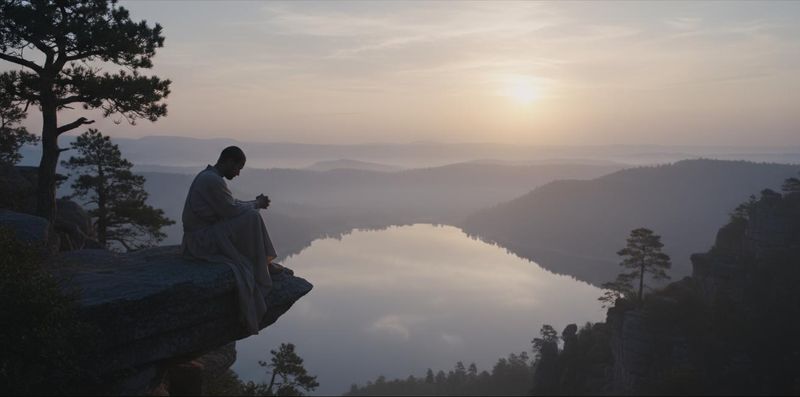
Change Is Certain
Peace is followed by disturbance. Change is a constant companion of life. What can help us navigate it more easily and resiliently is contemplation — the ability to be fully present in the moment, the now.
There are many forms of change. One of the most powerful foundations is to strengthen our awareness and consciousness by being completely present in the now.
Spiritual traditions and religions have found many different names for what we are talking about here: no-mind, not-doing, halt the world, halt the wheel of time, to be centered, to transcend the Ego, to come to presence, mystic contemplation, or simply contemplation.
All these traditions have discovered profound effects of the contemplative mind: it brings you much closer to your real self — the prima materia within you, not your Ego — it improves the quality of your relationships with other beings, and it connects you with the fundamental power of life.
The Contemplative Mind
Anyone who has ever practiced meditation has probably caught a glimpse of it. It is a state of pure focus in the present moment. You simply perceive what is around you — without thinking about it, without classifying, without trying to change or control anything: not your surroundings, not your feelings, not your thoughts.
In this state, many thoughts may still arise — you just let them pass. That is why it is sometimes called no-mind: it feels very different from our everyday mind. Normally, we cling to the past or the future, constantly thinking about what has been or what might come. We compare ourselves to others and project those comparisons into the future.
Our intellect — our inner dialogue — keeps this flywheel turning. It is not far from a subtle kind of compulsion. The Ego keeps checking whether it is still there, still alive.
When you become completely centered in the here and now, you encounter something distinct from your Ego. At first, you may feel a sense of emptiness or mild anxiety. It is the anxiety of the Ego, afraid of fading when there is no inner dialogue to confirm its existence.
If you can stay with that discomfort, the state becomes calm, restorative, and powerful. It brings a quiet confidence that comes from the simple fact that you exist — right here, right now.
Contemplation also acts as an inner cleanser. It can peel away the “onion skins” of your inner self and sometimes uncover barriers that prevent your natural power from shining through. These barriers can take many forms — regrets, greed, hate, anger, or addictions such as the pursuit of power, money, or fame.
By bringing them to the surface, contemplation prepares the way toward your real core — the alchemist’s philosopher’s stone within you. It begins the process of inner healing and wholeness.
So don’t be afraid if emotions arise in your heart or mind. We are not trying to get rid of them. Simply observe them for a while, allow them to be, and stay present in the here and now. Don’t analyze them and don’t try to change them. Let the inner silence dissolve them, step by step.
The Ego
Our Ego — not our 'real' self (if it exists 🤔) — keeps the inner dialogue running. Why? Because the Ego is afraid of dying, and that constant inner talk keeps it alive. Its ongoing mantra is: “I’m still here… I’m still here.”
This constant chatter may seem harmless, but it shapes everything. It creates thoughts, and through repetition those thoughts enter the unconscious. Once there, they form deep grooves — automatic reactions that influence how we feel, think, and behave.
These patterns shape not only our emotions but also our health, relationships, and the overall flow of our lives. The body responds to unconscious signals — to what we feel and radiate. Health or illness, harmony or conflict, attraction or repulsion: all of it resonates with our inner state.
The Ego therefore dominates most of our everyday mind. It has become a false god — one that believes it controls everything through its so-called free will. It tempts us with the illusion of autonomy: the idea that we can choose and direct everything. But in truth, we live upon an ocean of givens: we exist in a life-supporting phase of the universe, on a planet at the right distance from its sun. Life once emerged and evolved through endless transformations before we appeared. We are born into families, conditioned by our environments, shaped by culture, history, and biology.
Even our bodies function almost entirely without our conscious control — millions of processes every second, perfectly orchestrated. No Ego could ever manage that. All of this is given — freely, constantly.
Still, the Ego wants to remain in charge. It behaves like a dark god: not a creator but a dictator. It wants to be worshipped and suppresses anything that could threaten its rule. In doing so, it blocks our inner light and can keep us in darkness.
The Abrahamic religions teach that God created humankind in His image (Gen 1:26). The Ego has turned this upside down: it created a god in its own image — an emperor, a judge, a punisher. Thus the Ego becomes an opponent to the divine core within us — the Christ, the Buddha-Nature, the Atman/Brahman. Instead of connecting with the prime power behind existence, it distracts us with worldly pursuits: the striving for prosperity, power, fame, constant comparison, and competition.
The Ego must compete because it denies the abundance within. It makes us believe in scarcity: if someone else has more, we must have less. So we fight for a bigger piece of the cake.
Well-Known Ways Out
None of this is new. Humanity has known it for thousands of years.
There are two main ways out of the Ego’s grip:
Changing the Ego through the conscious and unconscious mind.
Going beyond the Ego, transcending it.
The first path includes the many self-improvement movements: positive thinking, constructivism, self-management, psychotherapy, general semantics, hypnosis, auto-suggestion, NLP, and similar approaches. These methods help us observe our thoughts and emotions, clarify our values (“Who and Where am I? Where do I want to go and Why?”), and change our behavior accordingly. They are valuable as long as we live in this world.
The second path goes beyond the Ego and connects directly with the prime power — the silence of the contemplative mind that gradually dissolves the Ego.
Both paths are useful and complement each other. Yet it is important to remember: you cannot heal a disease with the disease itself. You cannot overcome the processes of the Ego by using the Ego’s own tools.
You don’t fight darkness by analyzing it — you turn on the light.