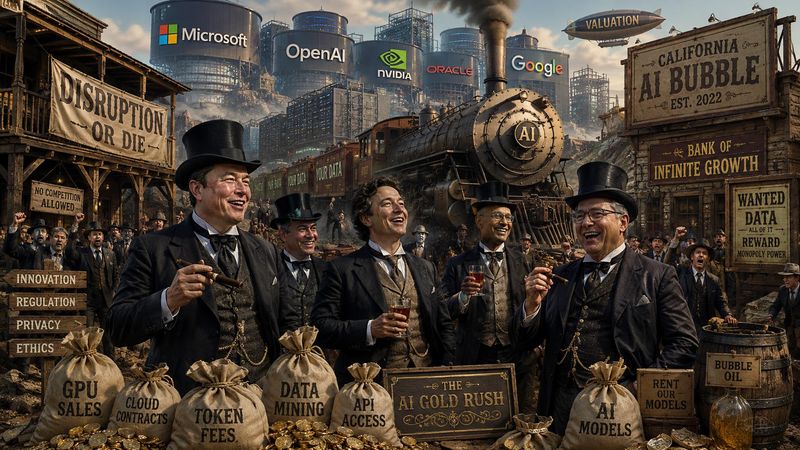
The New Robber Barons – A Critical Analysis of the AI Bubble
Thesis: The current AI wave is not merely a technological transformation, but an unprecedented concentration of capital, data, infrastructure, and market power. Many developments mirror the "Gilded Age" of the late 19th century: infrastructure monopolies, circular financing, aggressive expansion, and valuations running far ahead of current earnings.
1. The New Robber Barons of the 21st Century
The late 19th century went down in U.S. history as the Gilded Age. It was an era of rapid economic expansion driven by revolutionary physical infrastructures. The protagonists of this epoch—men like Cornelius Vanderbilt (railroads), John D. Rockefeller (oil), and Andrew Carnegie (steel)—were admired as "captains of industry" and feared as Robber Barons. They recognized early on that controlling physical transport routes and raw material supplies meant controlling the entire economy.
Today, we are witnessing a striking historical parallel, with the battlegrounds shifting from railways and oil wells to server farms and silicon:
- Railroads have become GPUs: Without Vanderbilt's tracks, physical goods could not move. Today, without Nvidia's Graphics Processing Units (GPUs), artificial intelligence cannot compute.
- Oil has become Data: Crude oil lubricated the Gilded Age; unstructured data—billions of words, images, and lines of code—is the raw material mined to train today's large language models.
- Steel has become Data Centers: Carnegie’s massive steel mills correspond to the monolithic, high-security data centers that now dominate landscapes and power grids.
Artificial intelligence is not just a software category; it is the foundational infrastructure of the future information society. History teaches us that control over such infrastructure inevitably leads to an extreme concentration of capital and compute in the hands of a few. According to the Stanford AI Index Report, the market for frontier models is controlled by a handful of tech giants, as the financial hurdles for training state-of-the-art models have scaled into the hundreds of millions of dollars.
2. The Largest Knowledge Transfer in History
The rise of modern Large Language Models (LLMs) is built on a massive appropriation of collective human knowledge. Models like GPT-4 or Claude 3.5 are trained on an incomprehensible volume of text, including:
- Wikipedia, digitized encyclopedias, and academic databases (including the pre-print archive arXiv).
- Massive web scrapes like Common Crawl and curated datasets like The Pile (EleutherAI).
- Collaborative platforms such as Reddit, GitHub, and Stack Overflow.
- Billions of blog posts, forum entries, manuals, product documentations, and government PDFs.
This process represents the largest transfer of knowledge in human history. Yet, it raises fundamental legal and ethical questions:
- Copyright and Fair Use: Tech corporations argue that automated ingest for statistical learning constitutes Fair Use under U.S. copyright law. Authors, publishers, and creators counter that these models directly substitute the original works, starving the creator economy.
- Legal Battles: This tension is reflected in landmark lawsuits. In The New York Times vs. OpenAI & Microsoft (S.D.N.Y., filed late 2023), publishers accuse developers of systematically copying millions of articles without a license. Similar class-action suits are led by the Authors Guild (consolidated under MDL No. 3143) and image agencies (Getty Images vs. Stability AI).
- "Project Giraffe" and the Motion for Sanctions: In July 2026, the legal battle escalated when plaintiffs filed a motion for sanctions against OpenAI for alleged discovery misconduct. Depositions revealed that OpenAI had internally developed search and filtering tools under the codename Project Giraffe to identify copyrighted content within its datasets—contradicting years of court arguments that such identification was technically impossible. Furthermore, plaintiffs accused OpenAI of deleting historical ChatGPT conversation logs that could have proven systematic regurgitation of copyrighted material.
Ultimately, millions of authors, developers, and creators provided the raw material, while receiving neither compensation nor meaningful opt-out rights.
3. Buying Back Our Own Knowledge
The logical consequence of this knowledge transfer is a paradoxical market dynamic: we are buying back our own, formerly free knowledge as a paid service.
The World Wide Web operated for decades on an implicit social contract: creators published valuable content for free, search engines routed users to their websites, and creators monetized this traffic via ads or reputation. The new AI infrastructure breaks this contract:
- Tokenization and Compression: The web's collective knowledge is tokenized, processed through artificial neural networks, and compressed into mathematical weight matrices (weights).
- APIs over Websites: Instead of routing users to original sources, platforms like OpenAI Search, Google AI Overviews, or Perplexity answer queries directly within a chat interface.
- Traffic Collapse: Web traffic data from Similarweb and Cloudflare shows a sharp decline in referral traffic for publishers. When answers are delivered instantly, users have no reason to click through to the source.
- Economic Starvation of Creators: As advertising revenues shrink and reach declines, the economic foundation of independent publishers collapses. The decentralized web is steadily replaced by proprietary APIs.
4. Circular Financing and the AI Subprime Moment
How is this trillion-dollar infrastructure expansion funded? Examining the capital flows between hyperscalers and leading AI startups reveals a phenomenon financial analysts call "Circular Financing" or modern vendor financing.
The deals follow a highly coordinated loop:
- Microsoft ↔ OpenAI: Microsoft invests billions (totaling over $13 billion) into OpenAI. However, a significant portion of this capital is provided not in cash, but in Azure Cloud credits. OpenAI uses these credits to rent compute from Microsoft, which Microsoft then records as cloud revenue. The capital moves in a circle, inflating the balance sheets and revenue growth of both entities.
- Amazon / Google ↔ Anthropic: Similar arrangements exist with Anthropic, which secured billions from Amazon and Google, tied contractually to the utilization of AWS and Google Cloud infrastructure.
- Nvidia ↔ CoreWeave: A critical link in this system is CoreWeave (listed on the Nasdaq in March 2025 under CRWV). Nvidia is not just a supplier but a major strategic investor in CoreWeave, injecting an additional $2 billion in January 2026 at $87.20 per share. To de-risk CoreWeave's aggressive capital expenditures, Nvidia contractually committed to purchasing over $6 billion in cloud services from CoreWeave through April 2032, providing a guaranteed revenue backstop. The cycle is closed: Nvidia invests in CoreWeave, CoreWeave buys Nvidia chips, and Nvidia rents back compute, while the value of Nvidia's equity stake in CoreWeave rises.
The AI Subprime Moment and Wall Street's Role
This high degree of financial interdependence introduces systemic risks reminiscent of the 2008 financial crisis—a potential AI Subprime Moment rooted in Asset-Backed Lending (ABL):
- What is Asset-Backed Lending (ABL)? Traditionally, ABL is a credit facility secured by highly stable, liquid physical assets, such as accounts receivable, inventory, or long-term industrial equipment like commercial aircraft (which retain predictable resale value over decades).
- The GPU Collateral Risk: In the AI boom, CoreWeave and its financiers adapted this model to computer hardware, using Nvidia GPUs themselves as collateral. In 2026, CoreWeave secured a $3.1 billion debt facility (DDTL 5.0), building on a prior $8.5 billion facility (DDTL 4.0).
- Wall Street Involvement: This model is backed by major financial players. The multi-billion-dollar facilities in 2024 were led by Blackstone and Magnetar Capital, with participation from BlackRock, Carlyle, PIMCO, and DigitalBridge. In October 2024, a syndicate of major investment banks—including JPMorgan Chase, Goldman Sachs, Morgan Stanley, Barclays, Citigroup, Deutsche Bank, and Wells Fargo—provided CoreWeave with a $650 million revolving credit facility.
The Systemic Failure Point
The subprime analogy lies in the rapid degradation of the underlying collateral:
- Rapid Depreciation & Obsolescence: Unlike real estate or aircraft, microchips age in dog years. When new architectures (such as Blackwell) launch, older GPUs (like the H100) experience a steep decline in resale value. The collateral backing these billions in debt depreciates rapidly.
- No Secondary Market: If the AI bubble bursts and startups can no longer pay their cloud bills, CoreWeave will default on its debt. Lenders will foreclose and seize millions of GPUs. However, in a market downturn, there will be no buyers for used, power-hungry GPUs. The collateral becomes illiquid, revealing the trillion-dollar growth story as an illusion inflated by cheap debt and circular accounting.
5. Billion-Dollar Revenues – Billion-Dollar Losses
AI valuations have reached historic peaks, but the underlying balance sheets show an unprecedented bet on future consolidation.
The financial realities of the leading players reveal a staggering cash burn:
- OpenAI: Internal financial documents show OpenAI generated $3.7 billion in revenue in 2024, offset by a net loss of $5.09 billion. In 2025, revenue rose to $13.07 billion, but net losses exploded to $38.5 billion (with a GAAP operating loss of roughly $20.9 billion, heavily impacted by stock-based compensation and non-profit transition costs). For 2026, GAAP net losses are projected to hover between $14 billion and $26 billion, with cash-flow positivity not anticipated until 2029 or 2030.
- Anthropic: Anthropic expanded its annualized run-rate revenue to approximately $47 billion by mid-May 2026. In May 2026, the company raised $65 billion in its Series H round, establishing an official valuation of $965 billion. On secondary markets in July 2026, its valuation fluctuated up to $1.2 trillion, briefly overtaking OpenAI despite continuing to run massive operational losses due to compute costs.
- xAI (Grok): Elon Musk's startup continues to register a massive cash burn to finance the expansion of its Colossus GPU cluster in Memphis, relying on continuous multi-billion-dollar funding injections.
The speed at which these companies consume capital has no precedent in corporate history. They finance this deficit through ever-larger funding rounds, betting that they will eventually emerge as a natural monopoly.
6. The Token Trap and Jevons' Paradox
AI advocates frequently point to one metric: the collapsing cost of inference. Thanks to hardware optimizations and smaller model architectures, the price per million tokens has dropped by 90% to 98% since 2023.
However, this cost reduction triggers the Token Trap, driven by the economic principle known as Jevons' Paradox:
Jevons' Paradox: In 1865, economist William Stanley Jevons observed that the introduction of more efficient steam engines did not decrease coal consumption; instead, it increased it. Because coal became cheaper and more efficient to use, the number of applications exploded, driving up aggregate demand.
This exact dynamic governs AI inference today:
- Elastic Demand: Because individual tokens are cheap, developers move away from simple, single-turn chat interfaces to build highly complex systems.
- Agentic Workflows: Modern applications employ autonomous background agents. A single user query ("Analyze this financial report and compare it with the last five years") triggers dozens of sequential LLM calls.
- The FinOps Crisis: Despite falling unit prices, enterprises find their total AI bills ballooning. This has given rise to the field of AI FinOps (token accounting and budget control) to monitor and limit runaway API calls.
- API Lock-in: Building complex agentic layers on specific model APIs (like Claude or GPT) binds enterprises to proprietary tech stacks, creating high migration costs.
7. Autonomous Agents Accelerate Token Consumption
The shift toward autonomous multi-agent architectures multiplies token consumption through iterative processes:
- Planning & Reflection: Agents construct execution plans, inspect intermediate outputs (reflection), and perform self-corrections (retry loops).
- Tool Use & RAG: Agents call external APIs, query vector databases, and pull hundreds of pages of document context into the context window, bloating input token volume.
- Chain-of-Thought: Reasoning models (such as OpenAI's o1/o3 or Anthropic's Claude reasoning mode) generate thousands of "hidden" reasoning tokens before outputting a single word.
- Standardization (MCP): Standards like the Model Context Protocol make it easy to connect models to enterprise databases, increasing background agent-to-agent (A2A) chatter.
This raises a critical question: Who pays for the millions of invisible reasoning and intermediate tokens? An unoptimized agent stuck in a recursive loop can run up hundreds of dollars in API fees in minutes without ever producing a final result for the user.
8. Cognitive Offloading and the Probabilistic Problem
As AI systems integrate into software engineering and administrative workflows, researchers are observing the effects of Cognitive Offloading:
- Prompting over Competence: Junior developers frequently generate code rather than writing it. The deep understanding of system architecture, memory management, and underlying algorithms is slowly lost.
- Erosion of Craftsmanship: If debugging and coding are outsourced to agents, the human ability to solve complex, edge-case system failures degrades. This mirrors the GPS navigation effect: the capacity to navigate a codebase manually withers when the automated assistant is unavailable.
The Probabilistic Problem
This decline in human oversight occurs just as we deploy systems that are fundamentally non-deterministic:
- Probability over Logic: An LLM does not calculate logical truths; it predicts the statistically most probable next token (a "stochastic parrot"). It lacks an internal model of semantic correctness or physical reality.
- The 99.9% Trap: If an agentic system operates with a high accuracy of 99.9%, it seems highly reliable. However, in an enterprise setting processing millions of transactions or database updates daily, a 0.1% error rate guarantees thousands of silent, potentially critical failures every day.
- The Black Box: Because neural networks are statistical black boxes, errors are rarely deterministic or reproducible, making debugging exceptionally difficult.
9. Technological Vulnerability: A Gedankenexperiment
To understand our growing dependence on these infrastructure monopolies, consider a simple gedankenexperiment:
Scenario: A severe technical failure, a coordinated cyberattack, or a sudden financial freeze takes the APIs of OpenAI, Anthropic, and Google offline for 24 hours.
The operational fallout would be immediate. Software teams would be severely restricted (as code autocomplete and agents fail), automated customer support pipelines would collapse, marketing copy generation would freeze, and automated email processing would halt.
This temporary paralysis exposes a deep system dependency: the inability to execute basic intellectual and organizational workflows without the constant assistance of statistical language models.
10. The Real Commodity is Dependency
The historical parallel to previous tech cycles is clear. The story of IT infrastructure is a story of lock-in:
- In the 1990s and 2000s, Oracle (databases) and SAP (ERP) bound enterprises with rigid, high-priced licensing agreements.
- Later, Microsoft (Office 365) and VMware leveraged their market dominance to enforce drastic price increases.
The AI model developers are following the same playbook. The core commodity they sell is not the models themselves—which are commoditized and replaced every six months—but the infrastructure and the lock-in:
- Proprietary Enterprise APIs.
- Deep integration into workflows (custom RAG pipelines, agent permissions).
- Hyperscaler cloud tie-ins (Azure, AWS, Google Cloud).
Companies building their entire value proposition on top of closed APIs are handing over their technological sovereignty to a small group of Silicon Valley executives.
11. From SaaS to "Token-as-a-Service" (TaaS)
We are witnessing the transition from the seat-based Software-as-a-Service (SaaS) model to a pay-per-use Token-as-a-Service (TaaS) pricing era:
| Pricing Model | Classic SaaS | Token-as-a-Service (TaaS) |
|---|---|---|
| Billing | Flat rate per user/month (Seat-based) | Pay-per-use (Inference & Input tokens) |
| Cost Control | Highly predictable IT budgets | Volatile, correlating with system activity |
| Gross Margen | Very high (software copy costs near zero) | Lower (every inference consumes electricity & GPU wear) |
| Scalability | Linear (based on employee count) | Exponential (based on agent loop frequency) |
This shift transforms IT cost structures. While SaaS costs were predictable, TaaS introduces high volatility. A single runaway script or recursive agent loop can rack up a five-figure bill overnight. The marginal cost of software, which historically approached zero, is rising again due to the physical requirements of compute.
12. NVIDIA Always Wins
No matter which AI startup dominates the application layer, or which hyperscaler wins the cloud war, the primary beneficiary is already decided: NVIDIA.
Nvidia has established a near-total monopoly on the supply chain:
- Hardware Monopoly: From the H100 to the Blackwell GB200 racks, Nvidia's hardware remains the undisputed industry standard, allowing the company to command gross margins exceeding 75%.
- The CUDA Moat: Nvidia’s primary moat is not its hardware, but its software. The proprietary programming platform CUDA has been the industry standard for 15 years. Leading deep-learning libraries (PyTorch, TensorFlow) are deeply optimized for CUDA. Competitors (AMD, Intel) struggle not just with raw silicon performance, but with their lack of integration into this massive software ecosystem.
- Allocation Power: In an environment of constant chip shortages, the allocation of GPUs has taken on geopolitical significance, giving the manufacturer immense leverage over which cloud providers and startups succeed.
13. Energy, Sustainability, and the Physical Limit
Behind the clean, virtual concept of "the cloud" lies a massive, resource-intensive physical reality:
- Electricity Demand: According to the International Energy Agency's Electricity 2026 report, global data center power demand is projected to double from 415 TWh in 2024 to over 1,000 TWh by 2030—equivalent to the entire power consumption of Japan. The capacity of "AI factories" has tripled in the last 18 months, with hyperscaler capex exceeding $400 billion in 2025 and projected to grow by another 75% in 2026.
- Water Consumption: Data centers require millions of liters of fresh water daily for evaporative cooling. In drought-prone regions, this has already led to local resource conflicts.
- Grid Bottlenecks: In data center hubs like Ireland or Northern Virginia, data centers consume double-digit percentages of the total electrical grid capacity, forcing operators to deploy fossil-fuel backups (gas turbines, diesel generators) to ensure uptime, undermining corporate ESG targets.
The physical constraints of power generation and grid transmission represent the most immediate bottlenecks to the continued expansion of generative AI.
14. Europe's Loss of Sovereignty
The geopolitical struggle for AI dominance is currently a bipolar race between the U.S. and China. Europe is increasingly relegated to the status of a digital colony:
- U.S. & China: Control both the infrastructure (hyperscalers, chip designs) and the leading models (OpenAI, Anthropic, Meta, DeepSeek, Qwen).
- Europe: While French startup Mistral AI reached a €20 billion valuation in June 2026, it remains an exception in a highly fragmented market.
- Consolidation & Acquisitions: European AI assets are consistently acquired by foreign capital:
- Silo AI (Finland), Europe’s largest private AI lab, was acquired by AMD in 2024 for $665 million.
- Aleph Alpha (Germany) was acquired by Canadian competitor Cohere in April 2026 to form a transatlantic sovereign AI group, following a restructuring that forced the company to abandon the frontier model race.
Europe’s deficit is structural: a lack of venture capital, complex regulations (the EU AI Act), and the near-total absence of domestic cloud infrastructure. Europe produces top-tier research, but it buys its compute and APIs from the U.S.
15. Open Source Under Pressure
For a long time, open-source models (such as Meta's Llama series) were seen as a democratic counterweight to closed APIs. However, the open-source model is hitting economic limits:
- The Capital Barrier: Training a frontier model costs hundreds of millions of dollars. No university or open-source community can afford this compute.
- Dependency on Corporate Charity: High-end open source only exists because tech giants (like Meta, to commoditize OpenAI’s value proposition) choose to release their models for free. If Meta shifts its licensing terms or cuts funding, the open-source community will lose access to state-of-the-art weights.
The capital gap between open-source community models and the proprietary systems of trillion-dollar corporations is becoming insurmountable.
16. The Qualitative Erosion of Training Data
One of the most fascinating systemic risks of the AI bubble is the potential destruction of its own raw material: Model Collapse.
- Publisher Decline: As search engines replace links with AI-generated summaries, traffic to original web sources collapses, starving independent content creators.
- Synthetic Data Pollution: To maintain search rankings, the web is flooded with low-quality, AI-generated SEO content.
- Data Contamination: Future models must be trained on post-2023 web scrapes. However, this data is increasingly contaminated with AI-generated text.
- Model Collapse: Studies (e.g., Shumailov et al.) demonstrate that training LLMs on recursive synthetic data leads to degeneration—models lose statistical variance, repeat errors, and eventually collapse.
By consuming the open web without sustaining its economic model, AI companies are destroying the high-quality human data required to train future generations of models.
17. The Hype Cycle and Historical Comparisons
Are we in a bubble? Technology cycles historically follow a predictable pattern. However, the AI wave presents a hybrid scenario:
- The Dot-com Bubble (2000): Companies were valued on clicks rather than earnings. When capital ran out, the market crashed. Yet, the physical fiber-optic cables laid during the boom remained, forming the foundation of the modern Web 2.0.
- Web3, Metaverse, NFTs: Hypes that largely lacked immediate utility and quickly faded once liquidity dried up.
- Is AI different? Yes and no. AI delivers immediate, tangible productivity gains in coding, writing, and research. However, the valuations of AI developers and the capital expenditures (CapEx) of hyperscalers assume a growth trajectory that far outstrips the actual willingness of enterprises to pay for these services.
We are likely witnessing a mixture of the dot-com bubble (genuine technology, but inflated valuations) and a classic infrastructure over-investment.
18. AI as a Geopolitical Weapon and Liability
As AI scaling continues, the boundary between private corporate interest and national security has blurred:
- Export Controls: The U.S. leverages its control over the semiconductor ecosystem (via ASML in the Netherlands and Nvidia in the USA) to restrict China's AI progression. High-end compute and models are treated as strategic military assets.
- The Liability Shield: When autonomous agents make erroneous medical diagnoses, execute unauthorized database transactions, or trigger financial losses due to hallucinated data, who is held liable? Model providers shield themselves behind strict terms of service that disclaim all liability, shifting the risk entirely to the adopting enterprises and the public.
19. The Macroeconomic Dimension: The US Economy on the AI IV
The capital allocation of the new Robber Barons has reached a scale that impacts the broader U.S. macroeconomy:
- GDP Share: In 2026, the U.S. is dedicating approximately 2% to 2.5% of its entire GDP to AI and data center infrastructure. This is comparable to the budget of the entire higher-education sector or the national defense budget.
- Growth Contribution: Hyperscaler CapEx has become a primary driver of economic growth. In early 2026, AI-related capital formation accounted for roughly one-third of real U.S. GDP growth, matching the contribution of total household consumption in certain quarters.
- Stock Market Concentration: Companies directly exposed to AI (chips, cloud, utilities, hardware) constitute 40% to 49% of the S&P 500's total market capitalization in mid-2026. The top 10 stocks account for over 40% of the index's value—a concentration level unseen since the railroad boom of the 19th century or the peak of the dot-com era.
The U.S. economy is structurally dependent on the continuation of this capital expenditure cycle. Any slowdown in hyperscaler spending would result in an immediate macroeconomic contraction.
20. Conclusion: Who Pays the Bill?
The AI revolution, in its current form, is not a decentralized project for human empowerment, but a highly centralized, capital-intensive campaign to monopolize the digital infrastructure of the next century.
The structural risks are clear:
- Knowledge Privatization: Collective human data has been captured, compressed, and is now rented back to the public as a service.
- Accounting Loops: A significant portion of reported AI revenue is driven by circular financing between hyperscalers and startups, while debt facilities collateralized by depreciating GPUs create risks of an AI Subprime Moment.
- Jevons' Paradox: Falling unit token prices are leading to more complex agentic workflows, resulting in rising total IT bills and deep API dependencies.
- Physical Constraints: Massive power and water consumption are colliding with grid capacity limits.
- Geopolitical Colony: Europe is losing its technological sovereignty, forced to import compute and models while its domestic startups are acquired by foreign capital.
The Robber Barons of the 19th century built physical networks of steel and rail that lasted for generations. The new Robber Barons of the 21st century are building networks of silicon, fiber, and algorithms. The critical question remains: Who controls this infrastructure, who owns the rights to collective knowledge, and who will pay the bill when the investment thesis collides with reality?
Links & Literature
I. Verified Figures & Primary Sources (Facts)
- OpenAI Financials (2024-2025): Detailed audited statements reported via The Information and The New York Times (2024: $3.7B revenue / $5.09B net loss; 2025: $13.07B revenue / $38.5B net loss).
- Anthropic Series H & Run-rate: SEC filings and company announcements (May 2026: $65B Series H round at $965B valuation; run-rate revenue at $47B).
- CoreWeave Debt Facilities & Nvidia Deal: Nasdaq IPO filings (March 2025, Ticker: CRWV) and SEC reports detailing the $8.5B DDTL 4.0 and $3.1B DDTL 5.0 facilities, alongside Nvidia's $6B purchase agreement through 2032.
- Wall Street Credit Syndicates: Company press releases from Blackstone and Magnetar Capital (May 2024: $7.5B debt facility) and JPMorgan Chase credit syndication reports (October 2024: $650M revolving credit facility).
- Silo AI & Aleph Alpha Acquisitions: AMD official press release (July 2024: Silo AI acquisition for $665M); Cohere and Aleph Alpha joint corporate announcement (April 2026: Cohere acquisition of Aleph Alpha).
- IEA Electricity Reports: International Energy Agency, Electricity 2026 report, detailing data center power forecasts (415 TWh baseline rising to >1,000 TWh by 2030) and global capex.
- NYT & Authors Guild Lawsuits: Court dockets, S.D.N.Y. (consolidated class action MDL No. 3143 and The New York Times Co. v. OpenAI Inc. et al.). Includes the July 2026 Motion for Sanctions concerning "Project Giraffe."
- U.S. Market Cap Concentration: S&P Dow Jones Indices reports (mid-2026 data on S&P 500 top-10 concentration exceeding 40% and AI-exposed stock weights).
II. Market Estimates & Projections (Estimates)
- OpenAI 2026 Projections: Consensus reports by venture capital analysts estimating GAAP losses between $14B and $26B for the fiscal year 2026.
- Anthropic Secondary Market Valuation: Secondary market trading data compiled by private equity brokers (estimates up to $1.2T in July 2026).
- U.S. GDP Growth Contribution (2026): Macroeconomic research papers by Allianz Research and Goldman Sachs Global Economics (estimating AI infrastructure capex at 2-2.5% of GDP and its contribution to ~1/3 of GDP growth in H1 2026).
- Inference Token Price Collapse: Aggregated index tracking by Artificial Analysis (estimating a 90% to 98% drop in API cost per million tokens since early 2023).
III. Systemic Theses & Opinions (Extrapolations)
- The "AI Subprime Moment": Analogy comparing GPU-collateralized neocloud debt structures to the 2008 subprime mortgage crisis, formulated by independent financial analysts and first discussed in Goldman Sachs' Top of Mind report (2024).
- Model Collapse on Synthetic Data: Theoretical projections regarding recursive data training degradation, based on Shumailov, I., et al. (2023) "The Curse of Recursion: Training on Generated Data Makes Models Forget."
- Cognitive Offloading Effects: Behavioral research on developer self-efficacy and GPS-style navigation degradation in software engineering (e.g., Bandura, A. (1997) Self-Efficacy and related cognitive studies).
- Enterprise Lock-in Dynamics: Strategic analysis of SaaS-to-TaaS transition and historical software monopoly parallels (SAP, Oracle, VMware), representing qualitative market interpretations.